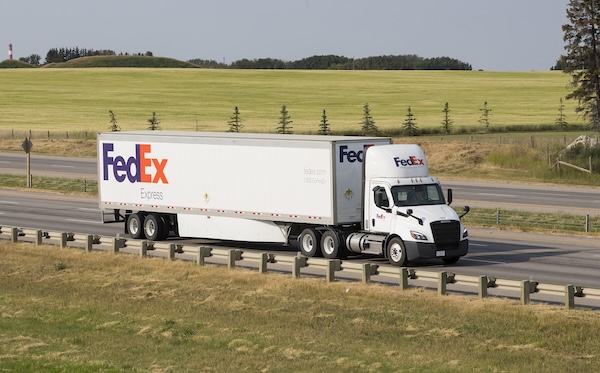
FedEx’s spin-off of FedEx Freight is a done deal
The long-awaited spin-off of FedEx Freight, the less-than-truckload (LTL) subsidiary of Memphis-based global freight transportation and logistics services provider FedEx, into a separately-traded public company was made official today.
Also, effective today, FedEx Freight is now listed as FDXF on the New York Stock Exchange, and has taken the place of American Airlines Group in the Dow Jones Transportation Average.
“The successful separation of FedEx Freight is a pivotal milestone, positioning two independent companies to lead their respective industries and create long-term value for their stockholders,” said Raj Subramaniam, FedEx president and chief executive officer. “Today’s spin-off positions FedEx Freight to build on its market-leading scale and a customer-focused culture, and advances the next chapter for FedEx as the industrial network that helps power the global economy.”
As previously reported by LM, in December 2024, the company’s Board of Directors, following a review of the role FedEx Freight, in its portfolio, elected to make a push to fully separate the unit into a new publicly-traded company. FedEx officials said at the time that this separation is expected to be completed within the next 18 months [from December 2024] and achieved in what the company called a tax-efficient manner for FedEx stockholders.
The development did not come as a surprise, considering that in its fiscal fourth quarter earnings announcement in June 2024, FedEx said it was “conducting an assessment of the role of FedEx Freight in the company’s portfolio structure and potential steps to further unlock sustainable shareholder value.”
FedEx Freight was created in in 2001, when FedEx Corp. acquired and merged the assets of American Freightways, Viking Freight and Watkins Motor Lines. It has since become the largest carrier in the LTL space. In 2024, it posted $9.1 billion in revenue to lead the market, according to figures compiled by SJ Consulting.
At its investor day in April, John Smith, FedEx Freight CEO, stressed how FedEx Freight is positioned to grow profitably as the leader in the North American LTL sector.
“We've always delivered for shareholders through FedEx, but now as an independent company, we are charting our own path, executing on our freight focused strategy to convert our strengths into high quality growth, enhanced profitability and expanded free cash flow,” said Smith. “We believe the spin will enable us to create significant value for our shareholders. Everything we do operationally and commercially supports these outcomes.”
Looking back at FedEx Freight’s origins, Smith observed that through its various acquisitions, it has established key national and regional lanes—including Viking Freight’s Western U.S. foothold, American Freightways’ regional network across the U.S., and Watkins Motor Lines’ long-haul network—which led to the 2011 creation on FedEx Freight’s Priority and Economic services running through a single network, with Priority serving 90% of the LTL market in three days or less from any of its locations and is 40% faster than its competitors, and Economy giving customers a more cost-effective, coupled with the same service levels as Priority. Smith noted that since then FedEx Freight has continued to invest into and expand its network, as well as rationalize it, to ensure it is in the right places where the freight is located.
“The footprint gives us the best locations, the best door capacity and the best transit times,” said Smith. “What you see today is the result of years of investment in scale, service and operational discipline. The foundation is a major reason we believe that FedEx Freight is positioned to continue to lead the industry. Going forward, building on this foundation, this year, we expect to generate $8.7 billion in revenue and approximately $1.1 billion in adjusted operating income, which translates into an operating margin of around 12%. These metrics demonstrate the high quality, profitable nature of our business. We operate from a position of strength. FedEx Freight is an established leader in the attractive LTL industry, firmly positioned to win today and into the future. We connect supply chains across North America transporting goods for companies of all sizes, industries and specialties, for manufacturers, distributors, industrials, retailers, e-commerce and beyond, our customers rely on us to move their goods quickly, efficiently and with superior service. The LTL industry has high barriers to entry to do what we do.”
Smith said some core focus areas for FedEx Freight include: optimizing its network, delivering a leading commercial offering, and advancing its technology capabilities, as well as delivering sustainable revenue growth driven by yield management and higher quality mix.
Addressing operations, FedEx Freight Chief Operating Officer Clint McCoy said that as FedEx freight integrated companies over the years, it ensured that it maintained the scale of their respective networks, while also evaluating service center concentration from its footprint. To that end, since 2003, McCoy said that FedEx Freight has consolidated 39 service centers, removed 1,000 doors, while adding nine new locations and 600 doors in strategic locations to expand its capabilities in the densest freight markets.
“The result is a network that is positioned where the freight is with unrivaled scale and proximity,” he said. “In a business where scale and proximity matter, we are positioned to absorb incremental volume with minimal additional capital investment, creating meaningful operating leverage through cycles. When you overlay where freight volumes are concentrated across North America, the strategic value of our network becomes clear. Our facilities and door capacity are located where the volumes are concentrated, allowing us to flex capacity efficiently maintain consistent service performance and capture profitable share as demand grows.”
On the sales side, McCoy said FedEx Freight has made strategic investments in building a dedicated LTL sales force, having hit its hiring target of 500 experienced LTL sales representative. As for pricing, he noted that FedEx Freight is committed to maintaining a rational pricing strategy, with a focus on generating high-quality revenue growth with an emphasis on yield. And he added that the company’s contracts are now structured more simply and cleanly, whereas, in the past, he described them as complicated.
Addressing customer mix, McCoy said FedEx Freight is focused on a few key segments, including: small- and medium-sized businesses (SMB), citing the need for services consistency timeliness, and digital consistency; healthcare, which has a total addressable market at around $6 billion, with reliability and time-definitive solutions being mission-critical; the $1 billion grocery market, with the company’s temperature-controlled and liftgate capabilities able to flex to serve customers seamlessly within its existing network, with an expanded market presence driving increased weight per shipment; the data centers and energy viewed as a $2 billion market, demanding flexibility, urgency, and security.
FedEx Freight’s pending spin-off comes at a time when many industry stakeholders maintain that LTL pricing, in some cases, has become irrational, according to Mike Regan, Chief Relationship Officer, at TranzAct Technologies.
“When you subtract out FedEx Freight and have it operating on a standalone basis, how does that impact its network, when it is no longer tied to Ground, in terms of plusses and minuses?” said Regan. “But in terms of where FedEx Freight wants to go, other LTL carriers are not as receptive. An LTL carrier CEO explained to me that if his company has trucks running at 27,000-to-28,000 pounds leaving a terminal, it is a good thing, with 22,000-to-23,000 pounds OK, because you are not losing money. But if trucks are running at 17,000-to-19,000 pounds, that is not a good picture.”
Regan observed that if a shipper is running in lanes where LTL carriers need freight, then the pricing will be very good, but if it is in freight lanes that are already well-established—and demand exceeds the supply—the pricing will not be as good.
Looking at the spin-off from a market perspective, Scooter Sayers, principal of Sayers Logistics, said that FedEx Freight is expecting generate business, based on its sales force investments, while also telegraphing to the market that it is going to be really zeroed in on revenue quality.
“What they're saying is, “We got a bunch of sales people. We want them to go get business,’ but they're going after the right business they think is going to be highly profitable to them. And if I'm a competitor. I'm saying, “You're not going to take my profitable business away from me.’ So, I think there is going to be some concern there, but not so much of a price war, but a customer war. How can I steal your customer without offering them a cheaper price? And that hurts you and helps me, because now I have better margin.”